EcoCloud's Second Year

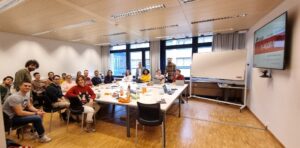
EcoCloud will host its second annual event on May 31st in Lausanne showcasing another year of pioneering interdisciplinary research on sustainable cloud computing. 

Please see our event's website for more info.

This year's program includes a keynote entitled "Big Data is (at least) Four Different Problems" by the database visionary Mike Stonebraker of MIT, followed by presentations from EcoCloud researchers, a poster session, and an industrial perspectives session form a group of experts among EcoCloud's industrial affiliates and partners.

The event brings together researchers and technologists from academia and industry interested in monetizing Big Data at maximum efficiency and minimal cost. EcoCloud's research highlights this year include technologies for massive analytics and graph processing, real-time and performance-stable cloud services, scalable parallel software, and data-centric server chips and infrastructure.

The industrial session includes talks by experts from EcoCloud's partners and affiliates including major IT vendors. Anne Holler from VMware and Paolo Faraboschi from HP Labs will each present their respective vision on Software-Defined Datacenters. Eric Chung from Microsoft Research will present hardware specialization for Big Data services. Peter Dickman of Google will present emerging efficiency challenges in Warehouse-Scale Computing.

The event is also a great opportunity for EcoCloud to showcase its Industrial Affiliates Program, promoting research collaborations with industry to help pave the way for impending technological challenges as well as problems on the horizon and outside industry's immediate concerns. "We target solutions towards a long-term vision for efficient and scalable data-centric IT that are also of value and interest to industrial partners in the short- and medium-term," says Babak Falsafi, EcoCloud’s Director and Professor in the School of Computer and Communication Sciences.

EcoCloud’s targeted research enables laboratories to work together towards a common goal, thereby propelling collaboration and the potential for trans-disciplinary innovation. In so doing, it echoes and reinforces the core ethos of EPFL itself.


Optimizing Datacenter TCO

Computing Now, the online portal highlighting IEEE Computer Society's top articles features Boris Grot's recent results on Optimizing Datacenter TCO with Scale-Out Processors.

The guest editor, Sundara Nagarajan writes "The article defines TCO as an optimization metric that considers the costs of real estate, power delivery and cooling infrastructure, hardware-acquisition costs, and operating expenses. This excellent study will have far-reaching impact on storage system architecture." To read the article, click here.

EcoCloud's Annual Newsletter


Welcome to EcoCloud’s second annual electronic newsletter! A full version of the newsletter is avialable here.

Our second annual event (in June 2012) was a great success thanks to EcoCloud researchers/staff, keynote and industrial session speakers, and student presenters. In this issue, we are delighted to announce two outstanding new members in our research community bringing a wealth knowledge and expertise, and report a number of achievements by EcoCloud members, making 2012 an even more productive year since we launched the center. Besides these accomplishments ranging from research highlights covered in international media to new projects and faculty and student awards, we are also happy to report that in 2012 we have introduced the EcoCloud Visiting Scholar program to attract world-renowned researchers to spend a sabbatical and collaborate with us.

This year, we will have our annual retreat on May 31st, 2013, at the same venue as last year, Hotel de la Paix in Lausanne. We look forward to seeing you there! 


Strong EcoCloud Presence at the Tech Tour Cloud & Big Data Summit

The Tech Tour Cloud & Big Data Summit, held at both the Lausanne Palace Hotel and EPFL Rolex Learning Center over 21-22 November 2012, has been a major showcase for the expertise of EcoCloud.

Prof. Babak Falsafi, Director, EcoCloud, was a member on Tuesday's Panel "Cloud Computing: The Ups and Downs." Additional speakers included: Rajas Gokhale, Capgemini, Tim Harper, Cientifica and Matthias Haendly, SAP. Prof. Falsafi also officially opened the Summit's proceedings on Wednesday.

Also that day, EcoCloud Executive Committee member Prof. Anastasia Ailamaki presented her research in a talk entitled "Scientific Discovery through Raw Data Exploration" and EcoCloud Scientist, EPFL & VMWare Co-Founder Dr. Edouard Bugnion gave the event's Keynote Speech.

Behind the scenes, EcoCloud's Deputy Director, Dr. Anne Wiggins contributed on the Summit's Selection Committee.

More information about the Tech Tour Cloud & Big Data Summit can be located here: http://www.techtour.com/Cloud-BigData-Summit-2012/Overview.htm


White paper on Cloud Computing in Switzerland

EcoCloud's Director, Prof. Babak Falsafi and Deputy Director, Dr. Anne Wiggins, collaborated on The Swiss Academy of Engineering Sciences' topical platform "ICT - Computing in science and technology" to write a white paper about "Cloud Computing in Switzerland".

To download the white paper in German:

2012-11-06_2_SATW_White_Paper_Cloud_Computing_DE.pdf

To download the white paper in English:

2012-11-06_2_SATW_White_Paper_Cloud_Computing_EN.pdf

RTS interviews EcoCloud's David Atienza

Also of EPFL’s Embedded Systems Laboratory, Prof. Atienza was interviewed last week by RTS about his joint laboratory and EcoCloud-related research, which has resulting in a 50% reduction of energy consumption in Credit Suisse datacenters. In the interview, Prof. Atienza was also asked more generally about cloud computing energy consumption optimization research and progress.

In addition, he was asked to comment about the idea of “micro-clouds” - http://www2.unine.ch/cms/site/unine/op/edit/lang/fr/23_octo_ - which is currently discussed to create localized hubs of cloud computing networks for specific restrictions of access to information.

Prof. Atienza indicated that this idea is very similar to the well-known concept of “private clouds”, which evidently make sense in specific contexts and that are a specific way to provide access. However, EcoCloud treats the problem of scalable and secured access to data in a more general way.

http://www.rts.ch/audio/la-1ere/programmes/cqfd/4359665-le-web-dans-les-nuages-01-11-2012.html
 
http://www.rts.ch/audio/la-1ere/programmes/cqfd/4359670-cqfd-01-11-2012.html

EuroCloud project chosen from 500 EU FP7 projects and presented to the EU parliament

Led by major research centers and industrial partners, including researchers from EPFL’s own EcoCloud research center and PARSA laboratory, the project marks the first occasion the EU has funded research focusing on servers and data centers. Today’s data centers consume extraordinary amounts of power, often measured in tens of megawatts per installation and equal to the power draw of 40,000 residential homes. The high power requirements are, in part, due to inefficiencies of existing server processors, which are deployed by thousands in each data center, yet are poorly matched to the memory-intensive software applications powering online services (including web search, social networking and business analytics). With data  centers already currently consuming approximately 2% of the global power budget, experts are projecting exponential growth in data center power consumption in the coming decades.

The physical space and power limitations that inhibit the growth – and increase the costs – of large-scale data centers must be overcome. Optimal performance of the memory-intensive software applications powering online services (including web search, social networking and business analytics) is hindered by inefficient chips, energy budgets and conventional server processors (which were designed for a broad range of workloads).

The EuroCloud project targets a 10x improvement in data center cost- and energy-efficiency, representing a major step toward sustainable data center IT. The EuroCloud team have been developing advanced low-power server architectures with many cores and integrating 3D DRAM to provide very dense low-power microprocessor technologies, adapted from those used in mobile phones. This This technology can scale to hundreds of cores in a single server, and make a 1M core data center feasible. The commercial application of these results would make European data center investment more affordable, thereby facilitating industrial growth. EuroCloud has laid the foundation for funding research on green data centers as a separate program in FP7 and Horizon 2020, the upcoming next-generation EU funding program.

European Commission Vice-President Neelie Kroes said: "Today's power-hungry cloud data centres are not sustainable in the long run. The EuroCloud chip addresses the core of this energy consumption problem. I hope further development of the EuroCloud chip will boost the position of European businesses in a sector currently dominated by non-Europeans."

Dr. Max Lemke, Deputy Head of Unit for Embedded Systems and Control in the Directorate General Information Society and Media of the European Commission, referred to the project in  order to illustrate how the main goal of research in computing systems is getting energy efficient and low-cost computing technologies into the full spectrum of devices and systems, from mobile and embedded systems to data centers and supercomputers. “Computing is a key enabler for Europe's competitiveness in engineering, which is a key driver for the European economy. Europe has to leverage its unique expertise in embedded and mobile computing systems to innovate in energy efficient and low-cost computing technologies," Dr. Lemke said.

DBToaster breaks up data jams in server farms

In gigantic server farms around the world, billions of database entries are queried every second. EcoCloud researchers have developed a system that drastically improves the circulation of this flow of information. The economic and environmental benefits are considerable.

Databases have revolutionized the business world. Every bottle of shampoo you buy, every purchase you make, is just one more data point sent out to your bank’s and your supermarket’s servers. This enormous quantity of detailed information allows merchants to optimize their inventories and displays and bankers to optimize the flow of money. Gigantic farms of servers are deployed in an effort to keep up with this breakneck pace of information storage and transfer. Researchers in EPFL’s DATA Laboratory have developed DBToaster, a system that speeds up the pace of operations by a factor of 100 – 10,000. The latest version has just been made available on www.dbtoaster.org.

“Ten years ago, CERN set up one of the world’s largest databases,” explains EPFL professor Christoph Koch, DBToaster’s creator. “Today, your average supermarket has a bigger system.” This inflation has escalated dramatically, to the point that optimizing databases has become an environmental issue. In the U.S., electricity use by server farms is growing exponentially, currently representing 2% of total electricity consumption.

Avoiding data jams by accelerating the flow of data
In a classic database, data are handled in a series of successive packets. For example, say a bank wants a list of all its clients who live in Zurich who have a balance of at least 5,000 francs. The user queries the database by selecting certain criteria. This request is translated into a series of mathematical operations. Because every banking transaction results in a separate database entry, the amount of information that must be sorted is phenomenal - the first operation has to search through billions of entries. The resulting data set is then sorted by the second operator, and so on, until the list is reduced to the clients desired.

The data are so vast that often the server’s RAM is not large enough to temporarily store initial results, causing a data jam. The server must temporarily store intermediate results on the hard disk before sending them on to the next operator. This slows things down considerably, because accessing the hard disk is 10,000 times slower than accessing RAM. It also requires much more electricity.

The EPFL scientists were able to get their system to compile successive operators as one single operator. This extremely complex operation makes it possible to store huge intermediate results. In doing so, DBToaster is able to efficiently prevent data jams.

Keeping queries in memory so you don’t have to reinvent the wheel
DBToaster has a second innovation, as well. The researchers took into account the fact that queries are often repetitive. “In general, the same operator is used many times within brief periods of time,” explains Koch. Rather than having to recalculate everything each time, the system keeps the preceding result in memory and merges it with new entries. “The big innovation with DBToaster is its ability to generate efficient code that manages to figure out how previous queries should be changed in order to be updated.” In this way, only recently entered data has to be queried, rather than billions of entries.

DBToaster is available online for no charge. Financial institutions, in particular, are enthusiastic about the system. According to Koch, DBToaster "enables analytical processing in real time, which financial institutions need to perform automated trading or to enforce regulatory compliance – for instance to detect patterns of money laundering in their streams of financial transactions.” But the benefits go farther than this. As data processing consumes escalating amounts of power, DBToaster is a solution that can be easily deployed on existing servers to reduce their electricity consumption and mitigate their impact on the environment.

Newspaper article from Le Temps

EcoCloud's Inaugural Annual Event

EcoCloud's Inaugural Annual Event will be held on Monday June 18th, 2012 at Hôtel de la Paix. For the program please click here.

Outstanding New Faculty Award


The Association for Computing Machinery's Special Interest Group on Design Automation has awarded its Outstanding New Faculty Award to EcoCloud's David Atienza, of the Embedded Systems Laboratory (ESL). This marks the first time that the award has been won outside the USA.

The Outstanding New Faculty Award recognises "a junior faculty member early in her or his academic career who demonstrates outstanding potential as an educator and researcher in the field of electronic design automation".

Clearing the Clouds: a major breakthrough in cloud computing efficiency

Cloud computing has emerged as a dominant computing platform providing billions of users world-wide with online services. The software applications powering these services, commonly referred to as scale-out workloads and which include web search, social networking and business analytics, tend to be characterized by massive working sets, high degrees of parallelism, and real-time constraints – features that set them apart from desktop, parallel and traditional commercial server applications. To support the growing popularity and continued expansion of cloud services, providers must overcome the physical space and power constraints that limit the growth of data centers. Problematically, the predominant processor micro-architecture is inherently inefficient for running these demanding scale-out workloads, which results in low compute density and poor trade-offs between performance and energy. Continuing the current trends for data production and analysis will further exacerbate these inefficiencies.

Improving the cloud’s computational resources whilst operating within physical constraints requires server efficiency to be optimized in order to ensure that server hardware meets the needs of scale-out workloads. To this end, the team of Babak Falsafi, a Professor in the School of Computer and Communication Sciences at EPFL, the director of the EcoCloud research center at EPFL (founded to innovate future energy-efficient and environmentally friendly cloud technologies) and a HiPEAC member, presented Clearing the Clouds: A Study of Emerging Workloads on Modern Hardware, which received the best paper award at ASPLOS 2012.

In this paper, the EPFL team explained how they used performance counters on modern servers to assess how well today’s predominant processor micro-architecture is aligned with the requirements of scale-out applications. What they discovered is that there is a significant mismatch between the two, stemming from inefficiencies in the instruction supply and execution logic as well as memory system organization. Their research shows that efficiently executing scale-out workloads requires optimizing the instruction-fetch path for multi-megabyte instruction working sets, reducing the core complexity, and shrinking the capacity of on-die caches to reduce area and power overheads. The authors also introduced CloudSuite, a benchmark suite of emerging scale-out workloads, that is expected to benefit the broader research community.

Scale-out Processors

The insights gleaned as part of the evaluation are now driving the team to develop server processors tuned to the demands of scale-out workloads. The team has recently proposed a processor organization that unlike current industrial chip design trends does away with power-hungry cores and large on-die caches and networks to free area and power for a large number of simple cores built around a streamlined memory hierarchy. Not only do these improvements lead to greater performance and efficiency at the level of each processor chip, they also enable significant cost and power savings at the level of an entire data center.

This work was partially funded by the EuroCloud Server Project, a European Commission FP7 Computing Systems Program and is deemed as a European “flagship” project, led by major research centers and industrial partners such as ARM, IMED, Nokia and the University of Cyprus. Running from Jan-2010 until Dec-2012, EuroCloud’s multiple partners are focused on increasing by 10x the efficiency in server chip level power consumption. Dr. Max Lemke, Deputy Head of Unit for Embedded Systems and Control in the Directorate General Information Society and Media of the European Commission, referred to the project to illustrate how the main goal of research in computing systems is getting energy efficient and low-cost computing technologies into the full spectrum of devices and systems, from mobile and embedded systems to data centers and supercomputers.

Computing is a key enabler for Europe's competitiveness in engineering, which is a key driver for the European economy,” Dr. Lemke said in his keynote address at the recent HiPEAC 2012 Conference. "Europe has to leverage its unique expertise in embedded and mobile computing systems to innovate in energy efficient and low-cost computing technologies," he added.

Profile

Babak joined the School of Computer and Communication Sciences at EPFL in 2008. Prior to that, he was a full Professor of Electrical & Computer Engineering and Computer Science at Carnegie Mellon where he led the Microarchitecture theme of the FCRP Center on Circuit and System Solutions, a multi-university consortium of over 50 academics investigating digital platform designs for the end of CMOS roadmap. He is the founding director of the EcoCloud research center pioneering future energy-efficient and environmentally-friendly cloud technologies at EPFL.

His research targets technology-scalable datacenters, design for dark silicon, architectural support for software and hardware robustness, and analytic and simulation tools for computer system performance evaluation. He is a recipient of an NSF CAREER award in 2000, IBM Faculty Partnership Awards in 2001, 2003 and 2004, and an Alfred P. Sloan Research Fellowship in 2004. He has been a member of ISCA Hall of Fame since 2003 and the Micro Hall of Fame since 2011 for contributions to the flagship IEEE/ACM conferences in computer architecture and microarchitecture respectively. He is a fellow of IEEE.

EPFL, the new Silcon Valley in French-speaking Switzerland

L'EPFL, nouvelle Silicon Valley romande

Le consortium des laboratoires informatiques de l'EPFL a décroché 1,7 million de francs auprès de partenaires industriels.

Né en 2008, le concept de "Big Data" fait désormais tendance. Pas de définition précise. Le terme englobe tout à la fois la problématique et les technologies visant à traiter le gigantes que volume d'informations généré par les technologies IT. Difficile de quantifier le phénomène. A en croire le magazine The Economist, quelque 1200 exaoctets (milliards de gigaoctets) circulent désormais via le réseau informatique, contre 150 exaoctets en 2005. La consommation énergétique des data centers progresse également de façon exponentielle. Aujourd'hui, on estime que l'empreinte carbone des centres de calcul équivaut à celle de la navigation aérienne internationale. En 2010, les technologies de l'information représentaient 1,5% de l'énergie consommée aux Etats Unis, soit 4,5 milliards de dollars.

La viabilité économique du secteur IT dépend désormais de sa capacité à juguler ses besoins énergétiques, commente Babak Falsafi, professeur au Laboratoire d'architecture de systèmes parallèles et directeur du centre de recherche EcoCloud, les deux à l'EPFL. Pour freiner le niveau de croissance actuel, il faut parvenir à décupler l'efficience des processeurs et des mémoires par un facteur de 100 d'ici à dix ans.

C'est l'objectif que s'est fixé EcoCloud. Fondé en mai 2011, le consortium réunit 13 laboratoires de l'Ecole polytechnique fédérale de Lausanne (EPFL). Spécialisés dans les processus de cloud computing et la gestion de Big Data, les 14 informaticiens concernés collaborent sur trois axes de recherche clef: les données, l'énergie et l'intelligence.

Le paradoxe est que le nuage informatique contribue à augmenter la circulation de données, tout en représentant aussi le meilleur pôle d'économie pour le secteur IT, observe Babak Falsafi. Jusqu'à présent, l'industrie s'est appliquée à réduire le voltage des puces électroniques pour éviter que la consommation énergétique n'augmente au même rythme que la puissance de calcul des processeurs. Nous arrivons toutefois au bout de cette logique et n'avons plus d'autre choix que de travailler à la mutualisation des ressources pour optimiser les performances des centres de traitement.

Ce nouveau concept de développement oblige à repenser la totalité des architectures et des connectivités des data centers. Il implique une démarche holistique et un travail coordonné tant au niveau des logiciels que du hardware, des serveurs et des systèmes de refroidissement.

Au nombre des pistes prometteuses mises en oeuvre par EcoCloud figure un projet visant à optimiser le fonctionnement des machines et l'acheminement des données. Un autre pôle de recherche travaille à réguler la température des processeurs en fonction des actions programmées.

D'autres laboratoires oeuvrent à une nouvelle agrégation des informations ou à la résolution de bugs logiciels entièrement automatisée. Dénominateur commun des recherches: concevoir des outils hautement spécialisés destinés à effectuer des tâches ciblées de manière plus efficace et moins énergivore.

La puce tridimensionnelle

Le Laboratoire d'architecture de systèmes parallèles de l'EPFL collabore à l'élaboration d'une nouvelle génération de puce électronique.

Jusqu'à présent, les processeurs étaient destinés à réaliser des opérations mathématiques, résume Babak Falsafi. Avec l'avènement du nuage, leurs performances ne se mesurent plus seulement à leur puissance de calcul, mais aussi à leur capacité à accéder aux informations disponibles sur de sserveurs distants. Les téléphones portables utilisent déjà une technologie de ce type. Son transfert au secteur informatique exige toutefois une optimisation de l'interconnectivité et des procédures de traitement de grands volumes de données. Alors que les processeurs traditionnels utilisent une architecture bidimensionnelle composée d'unités de calculs alignés côte à côte, les chercheurs de l'EPFL ont conçu une puce électronique en trois dimensions utilisant des coeurs superposés.

Fondée sur la technologie Through Silicon Vias, cette nouvelle architecture verticale multiplie les connexions et accélère d'au moins 10 fois la vitesse de traitement des données, précise le professeur.

Les transactions améliorées

De son côté, le laboratoire de systèmes et d'applications de traitement archide données massives (DIAS) développe des technologies destinées à doper la performance des ordinateurs et à faciliter le maniement du Big Data. "Avant l'arrivée du nuage informatique, il suffisait de disposer d'une mémoire suffisante pour lire et organiser une certaine quantité d'informations, observe Anastasia Aïlamaki, cofondatrice d'EcoCloud et directrice de DIAS. Aujourd'hui les systèmes doivent puiser les données dans des unités de stockage distantes et les combiner de façon à obtenir une réponse rapide et fiable. Notre concept contribue à accroître l'efficacité des systèmes et à quantifier les ressources nécessaires à leur fonctionnement." L'innovation s'applique notamment à la gestion des transactions financières. Dans une architecture traditionnelle, les ordres passés depuis plusieurs plateformes ne peuvent pas être effectués de manière simultanée. Les informations sont préalablement filtrées par un logiciel chargé de vérifier et de valider successivement chaque modification de valeur. Pour contourner ce verrouillage central qui participe à ralentir le trafic, DIAS a glissé une couche immatérielle dans son architecture logicielle. "Nous ne procédons pas à une structuration physique, mais à une organisation logique des informations, explique la directrice. Les données relatives à un même objet sont réunies dans des modules et transférées sous la forme d'une image virtuelle. Les processeurs concernés sont dès lors en mesure de synchroniser les opérations et de fournir des résultats quasi instantanés. La technologie garantit la fiabilité des transactions, tout en évaluant la puissance de calcul nécessaire à chaque opération. Les entreprises ont ainsi l'avantage de pouvoir planifier les ressources matérielles nécessaires à l'exécution des tâches qu'elles se sont fixées."

Soutiens pécuniaires

Les travaux relatifs à cette architecture des plus novatrices ont été publiés l'an dernier et le laboratoire de l'EPFL a d'ores et déjà élaboré un prototype convaincant. A en croire son instigatrice, le produit serait désormais exploitable par le marché. "La mise en oeuvre de notre solution obligerait toutefois à repenser la globalité des structures informatiques.

La voie d'implémentation plus rapide consisterait à utiliser nos recherches pour l'élaboration d'un nouveau système core banking", précise encore Anastasia Aïlamaki. Pour l' heure, aucun candidat ne s'est manifesté. Le laboratoire oeuvre désormais au développement d'un outil de récupération de données. Il affine également ses algorithmes afin d'assurer leur compatibilité avec les nouvelles mémoires de changement de phase. Mieux connues sous l'abréviation PCM pour Phase change memory, ces unités de stockage pourraient s'avérer jusqu'à lOfais plus rapides que la mémoire flash et 1000 fois plus efficaces que les disques mécaniques traditionnels.

Récemment présentées lors de prestigieuses conférences IT à Hanovre et Athènes, les innovations du laboratoire DIAS ont suscité l'enthousiasme des experts, et aussi décroché de précieux soutiens financiers. Oracle s'est ainsi engagée à financer un plan de recherche axé sur l'utilisation de processeurs multicorps. IBM subventionnera pour sa part les travaux relatifs aux nouveaux supports de stockage de l'information. Les contrats renouvelables portent sur le versement global de quelque 180 000 francs par an.

Les ambitions de CS

A l'instar de la majorité des laboratoires académiques, les membres du réseau EcoCloud monnaient leurs services auprès des entreprises. Ils bénéficient en outre d'un pot commun alloué au consortium par des fonds de recherche suisses et européens et des partenaires industriels. Credit Suisse, HP, IBM, Microsoft, Nokia, Oracle, Swisscom et Intel financent en effet le projet à raison de l,7 million de francs par an. Première banque à s'être installée dans le Quartier de l'innovation de l'EPFL début 2011, Credit Suisse ne cache pas ses ambitions en matière de développement IT et mise sur la coopération pour accélérer son innovation. "Les recherches menées au sein d'EcoCloud s'inscrivent dans la logique des projets amorcés par l'établissement, commente Hans Martin Graf, directeur du Centre de développement IT de CS. Nous travaillons à la décentralisation de nos infrastructures depuis près d'une dizaine d'années, alors que les processus de virtualisation présentent encore de nombreuses inconnues. La mise en commun des compétences des divers spécialistes de l'EPFL est d'autant plus prometteuse qu'elle offre une approche globale de l'ensemble des problématiques liées au cloud computing."

Réservoir de forces vives

Credit Suisse a entamé un programme d'optimisation énergétique de ses data centers avec le Laboratoire des systèmes intégrés de l'EPFL. Objectif: sélectionner les composants matériels et les systèmes les moins énergivores et les plus performants (voir aussi Green IT dans BAS septembre 2011). L'établissement bancaire négocie désormais de nouveaux axes de collaboration dans le domaine de la sécurité notamment. De nouveaux projets concrets devraient être lancés début 2012.

Dans l'intervalle, l'entreprise poursuit ses propres recherches dans le secteur du management de documents et des logiciels de gestion de portefeuille en particulier. Avec un investissement de quelque 10 millions de francs par an, le Centre de développement IT entend profiter des synergies offertes par son implantation au coeur de l'EPFL et souhaite affirmer son rôle d'employeur formateur. Forte d'une soixantaine de collaborateurs, la nouvelle entité de CS entend recruter une quinzaine de jeunes talents d'ici à la fin de l'année.

Une stratégie qui ne manquera pas de nourrir le réservoir de forces vives de l'établissement bancaire et participera sans nul doute à le préserver de la pénurie de spécialistes annoncée dans le secteur des technologies de l'information. La division informatique de CS emploie actuellement quelque 17 000 collaborateurs au plan mondial, dont 6000 en Suisse.

CloudSuite 1.0 Released

CloudSuite is a benchmark suite for emerging scale-out applications. The first release consists of six applications that have been selected based on their popularity in today's datacenters. The benchmarks are based on real-world software stacks and represent real-world setups. Please visit the CloudSuite web page for further information and instructoins on how to download the suite.

Clearing the Clouds

The emergence of global-scale online services has galvanized scale-out software, characterized by splitting vast datasets and massive computation across many independent servers. In a paper appearing in ASPLOS 2012, Profs. Ailamaki and Falsafi and their teams identify the inefficiencies in modern server processors and memory system when running emerging scale-out workloads (e.g., analytics, data serving, debugging as a service, video streaming and web) and advocate server chip architectures and hardware mechanisms that maximize silicon efficiency for these workloads. For more information see, Clearing the Clouds: A Study of Emerging Workloads on Modern Hardware by Ferdman et al., available as an EPFL Tech. Report.

Oracle Research Award

David Atienza is the recipient of an Oracle Outstanding Research Award in 2011 for contributions to stable global thermal-aware control for entreprise servers. Intelligent feedback-control algorithms are emerging as instrumental in controlling temperature in entreprise servers. Until just a few years ago, servers relied on only trivial control actuators based on high-temperature thresholds for asset protection. This award is given to David for the introduction of an intelligent global feedback-control algorith that combines multiple local controllers, with gauranteed operation stability, to improve thermal characteristics and reduce energy in Oracle's future servers. Congratulations David!

Thrustworthy Cloud Storage

A team of six Swiss university laboratories, led by EcoCloud member Prof. Anastasia Ailamaki, received an award of CHF 1.5million for a project entitled "Trustworthy Cloud Storage". The project's goal is to enable the Swiss public to trust and use cloud storage infrastructure through the design and development of innovative technology that addresses the most crucial shortcomings of the current state-of-the-art. Cloud computing is our new world, in which everything is a service, and users subscribe to it without knowing where is the disk that holds their data or where is the processor that performs the computation. Although most people use cloud services, many are still reluctant to entrust the cloud with their most private data. The reasons are slow and unpredictable cloud storage, limited privacy or security, and questionable cloud properties. The team aspires to remedy the very roots of the aforementioned problems by developing innovative technology which improves performance and predictability, as well as security and verifiability of the cloud services.

The proposal's PI is Anastasia Ailamaki (EPFL). CoPIs are George Candea  (EPFL), Arjen Lenstra (EPFL), Fernando Pedone (Lugano), Pascal Felber (Neuchatel), and Srdjan Capkun (ETH).

Toward Dark Silicon

In a recent paper in IEEE Micro special issue on Big Chips, July 2011, EcoCloud researchers project that server chips will not scale beyond a few tens to low hundreds of cores, and an increasing fraction of the chip in future technologies will be dark silicon that one cannot afford to power. Specialized on-chip architectures can leverage the underutilized die area to overcome the initial power barrier, delivering significantly higher performance for the same bandwidth and power envelopes.

For more information see, Toward Dark Silicon in Servers by Hardavellas et al., in IEEE Micro, July of 2011.

Seeger wins ERC Grant

Decision making and quantifying risks based on uncertain knowledge are key challenges in an information and data-driven society, coming with unprecedented demands on algorithms and computation. These challenges
will be met in large-scale domains such as medical imaging and computer vision, advancing approximate Bayesian technology far beyond the state of the art.

Matthias Seeger was awarded an ERC Starting Grant "Scalable Bayesian Methods for Machine Learning and Imaging" to overcome such challenges and investigate technologies to enable massively parallel numerical computing, scalable optimization and data management for decision making with uncertainty. The ERC Starting Grant "aims to provide adequate support to researchers that demonstrate the potential to perform world-class research" with awards up to 2 millions euros. Congratulations Matthias!

SIGMOD 2011 demo award

We are super pleased to announce that EcoCloud researchers have also
won the best demo award this year at SIGMOD for the demo:
"A Data-oriented Transaction Execution Engine and Supporting Tools"
by Ippokratis Pandis, Pinar Tozun, Miguel Branco, Dimitris Karampinas, Danica Porobic, Ryan Johnson, Anastasia Ailamaki
Congrats to Prof. Ailamaki and her team!

EcoCloud in the news.


EPFL to tackle the electricity demand of data centers
EPF Lausanne announced today the launch of the ecocloud consortium. The consortium brings several EPFL laboratories together to tackle the skyrocketing electricity demands of Internet data processing centers.

More at The Swiss HPC Service Provider site


Au coeur d'une "ferme de calcul"
Les réseaux d'ordinateurs destinés aux calculs complexes consomment énormément d'énergie, un vice que le consortium Ecocloud, à l'EPFL, vise à combattre. Babak Falsafi et David Atienza l'expliquent au micro d'Impatience, sur RSR - La Première. L'émission multimédia Point-Barre, sur Couleur 3, s'y intéresse aussi.

Pour en savoir plus:
RSR - Impatience - Le consortium Ecocloud
Couleur 3 - Point Barre - Le consortium Ecocloud


EPFL präsentiert neues Kompetenzzentrum für Cloud Computing
Adrienne Corboud Fumagalli, Vice-President of Innovation and Technology Transfer, EPFL Energieeffizienz steigern, um Cloud Computing zu unterstützen, ist das Hauptziel des neuen Projektes "Ecocloud", initiiert von der EPFL. Damit antwortet die EPFL auf die steigenden Datenmengen in der Wolke.

Mehr lesen Sie unter Netzwoche


Régime énergétique
Ecocloud, le consortium de laboratoires de l'EPFL qui travaille sur la problématique de la consommation d'énergie dans les "data centers" fait l'objet d'un article dans "24 Heures".

Pour en savoir plus:
24 Heures: L'informatique devra se mettre au régime


Le stockage des données informatiques
Un centre de recherche dédié aux services cloud a été inauguré hier à Ecublens.

Pour en savoir plus:
L'AGEFI: EcoCloud table sur l'optimisation


SIGMOD 2011 Conference: top presence for EcoCloud researchers

Members of the Data-Intensive Applications and Systems Laboratory (DIAS) and Data Analysis Theory and Applications Laboratory (DATA) laboratories will have a total of eight entries in the proceedings (1 keynote, 4 research and 3 demonstration papers) and a best-paper award at this year's SIGMOD, the premier annual research conference in data management. SIGMOD will take place in Athens, Greece on June 12-16, 2011. At the conference, Prof. Anastasia Ailamaki (director of the DIAS lab) will deliver a keynote speech titled "Managing Scientific Data", while Prof. Christoph Koch (director of the DATA lab) will accept the SIGMOD 2011 Best Paper Award for his paper "Entangled queries: enabling declarative data-driven coordination", jointly authored with his Cornell colleagues Lucja Kot, Nitin Gupta, Sudip Roy, Gabriel Bender and Johannes Gehrke. Overall, an impressive EPFL IC presence at the creme-de-la-creme of data management research forums!

EcoCloud's Opening Event

Online registration is now closed. If you would like to attend please contact us. You can find the program here.

Google Focused Research Award for AutoSRS

Prof. George Candea's lab receives a Google Focused Research Award (see announcement) to build cloud-based automated software-reliability services.

This is a way to make advanced reliability techniques accessible and affordable to everyone in the world. We envision three types of AutoSRS: (1) An automated testing service that thoroughly tests code as developers write it, pointing out hidden bugs on the fly, similar to how automated spell checking works in modern text editors; (2) An automated debugging service that takes a program + bug report and walks the developer through how that particular code could have reached the particular buggy state described in the report; and (3) A public certification & rating service, akin to Underwriters Labs, which independently and automatically assesses the reliability, safety, and security of both commercial and open-source software. From a research point of view, we aim to make fully-automated testing and debugging (which today is mostly usable only on toy programs) scale to real-sized software by harnessing massive clusters of commodity hardware. From a social and business point of view, we want to offer universal access to top-of-the-line tools in a way that could improve global software quality in much the same way webmail improved people's ability to communicate.

Article on EcoCloud in Bilan

See our article on EcoCloud in Bilan from January 19th, 2011.


NEWS


EcoCloud's Second Year

On Friday May 31st, EcoCloud will host its second annual event.

Read More

Optimizing Datacenter TCO

The March issue of Computing Now highlights our results for designs to optimize datacenter efficiency.

Read More

EcoCloud's Annual Newsletter

Read about EcoCloud's accomplishments in 2012.

Read More